
Level Insight
At Speakitaly NYC, our Italian courses follow international standards (CEFR and ACTFL) and are backed by over 20 years of experience teaching students of all levels and backgrounds. Here is how our program works:
Not sure where you fit? Take our Placement Test today to find your perfect level!
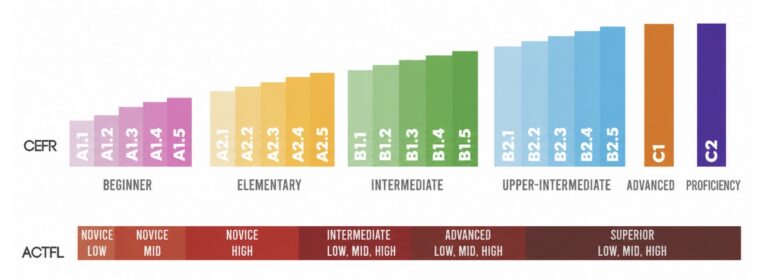

A1 – Beginner
The A1 levels are the beginning of the learner’s journey toward communicative competence in Italian. At this stage, learners begin communicating in predictable everyday situations using familiar vocabulary and simple sentence patterns. They acquire the language needed to manage simple everyday interactions, exchange personal information, and participate in highly supported communicative contexts. Communication is facilitated through clear input, familiar vocabulary and basic sentence structures, allowing learners to build confidence while establishing the foundations for future language development.
By the end of this stage:
- Communication: Confident participation in simple everyday interactions.
- Core language: Present tense, articles, gender and number agreement, reflexive and modal verbs.
- Vocabulary: Personal information, everyday communication and essential daily life terms.
- Real-life contexts: Introductions, family, shopping, food, daily routines and simple directions.
Communication Profile
Learners establish first-contact communication by introducing themselves, exchanging personal information, and interacting politely in highly predictable situations. They rely on familiar expressions and simple sentence patterns while developing confidence in using Italian for basic everyday communication.
Core Language Areas
- Present tense of high-frequency verbs
- Definite and indefinite articles
- Gender and number agreement
- Basic question forms
- Numbers and dates
- Subject pronouns
Real-Life Contexts
- Introducing yourself and meeting new people
- Talking about family and friends
- Greetings and introductions
- Classroom communication
- Talking about nationalities and languages
- Everyday personal information
Communication Profile
Learners communicate with increasing confidence in familiar situations. They begin combining previously acquired language to describe routines, express simple preferences, ask for information and manage a wider range of everyday interactions with reduced support.
Core Language Areas
- Present tense consolidation
- Reflexive verbs
- Modal verbs
- Common prepositions
- Basic connectors
- Simple adverbs of frequency
Real-Life Contexts
- Daily routines and personal life
- Shopping for everyday needs
- Ordering food and drinks
- Home and family life
- Free-time activities
- Asking for and giving simple directions

A2 – Elementary
The A2 levels represent an important step towards greater communicative independence. At this stage, learners expand their ability to use Italian in familiar everyday situations by combining previously acquired language with new vocabulary and more varied grammatical structures. They become more confident when exchanging information, describing experiences, expressing preferences and managing routine interactions in both personal and social contexts. Communication becomes increasingly spontaneous, allowing learners to participate more actively and effectively in everyday conversations.
By the end of this stage:
- Communication: Independent communication in familiar everyday situations.
- Core language: Present perfect, imperfect, future tense, pronouns and expanded connectors.
- Vocabulary: Broader vocabulary for travel, work, leisure, services and social interaction.
- Real-life contexts: Travel, restaurants, healthcare, housing, education, workplace and everyday services.
Communication Profile
Learners strengthen their ability to communicate in familiar contexts by exchanging information, describing people, places and daily activities, expressing preferences and managing routine situations with greater confidence. They rely less on memorised expressions and increasingly combine known language to communicate more naturally and effectively.
Core Language Areas
- Present Perfect (Passato Prossimo)
- Direct object pronouns
- Modal verbs
- Comparative forms
- Possessive pronouns
- Common adverbs and time expressions
- Expanded use of prepositions
Real-Life Contexts
- Family and personal relationships
- Shopping and consumer experiences
- Food, dining and social occasions
- Travel and transportation
- Leisure activities
- Health and well-being
- Managing everyday services
Communication Profile
Learners communicate with greater fluency and flexibility across a wider range of familiar situations. They describe past experiences, discuss future plans, express opinions, compare people and situations, and sustain longer conversations while adapting their language appropriately to different communicative contexts.
Core Language Areas
- Imperfect (Imperfetto)
- Contrast between Present Perfect (Passato Prossimo) and Imperfect (Imperfetto)
- Future Tense (Futuro Semplice)
- Indirect object pronouns
- Relative pronouns
- Expanded connectors
- More complex sentence structures
Real-Life Contexts
- Education and learning
- Workplace communication
- Housing and living arrangements
- Holidays and traditions
- Technology and digital communication
- Culture and entertainment
- Solving everyday problems

B1 – Intermediate
The B1 levels mark the transition from basic communication to independent language use. At this stage, learners develop the confidence and flexibility needed to communicate effectively in a wide range of familiar and unfamiliar situations. They can describe experiences, express opinions, explain reasons, discuss future plans and handle everyday interactions with increasing fluency. Learners become more autonomous in managing conversations and begin adapting their language according to different communicative contexts and purposes.
By the end of this stage:
- Communication: Independent communication with growing fluency across personal, social and professional contexts.
- Core language: Conditional mood, introduction to the subjunctive, complex sentences and cohesive devices.
- Vocabulary: Abstract topics, opinions, experiences, current events and intercultural communication.
- Real-life contexts: Workplace, education, travel, society, technology, media and personal projects.
Communication Profile
Learners move beyond routine communication by expressing opinions, describing experiences in greater detail and participating more actively in conversations. They begin supporting their ideas with simple explanations, asking follow-up questions and adapting their language according to the situation and the person they are speaking with.
Core Language Areas
- Review and consolidation of present, past and future tenses
- Imperative mood (Imperativo)
- Combined direct and indirect object pronouns
- Comparative and superlative structures
- Reflexive and reciprocal verbs
- Introduction to the Conditional Mood (Condizionale Presente)
- Expanded use of cohesive devices and connectors
Real-Life Contexts
- Workplace communication
- Education and lifelong learning
- Planning trips and travel experiences
- Health and lifestyle
- Relationships and social interactions
- Discussing current events
- Giving advice and making suggestions
Communication Profile
Learners communicate with greater confidence and flexibility across a wide variety of contexts. They narrate experiences, justify opinions, compare alternatives, solve problems collaboratively and sustain conversations with greater fluency and spontaneity. They increasingly adapt their language to different communicative purposes while maintaining accuracy and coherence.
Core Language Areas
- Conditional Mood (Condizionale Presente)
- Introduction to the Subjunctive Mood (Congiuntivo Presente)
- Relative pronouns
- Passive constructions (introduction)
- Reported speech (introduction)
- Complex sentence formation
- Advanced discourse markers
Real-Life Contexts
- Society and contemporary life
- Technology and communication
- Environmental awareness
- Arts and culture
- Media and entertainment
- Personal goals and future projects
- Intercultural communication

B2 – Upper Intermediate
The B2 levels represent a significant milestone in communicative competence. Learners use Italian confidently, effectively and appropriately across academic, professional and social contexts. They can discuss complex topics, support arguments with clear reasoning, negotiate meaning and adapt their language according to audience, purpose and context. Communication becomes increasingly fluent, accurate and natural, allowing learners to participate confidently in extended interactions.
By the end of this stage:
- Communication: Confident, flexible and effective communication in complex academic, professional and social settings.
- Core language: Advanced subjunctive, sequence of tenses, passive voice, register awareness and idiomatic language.
- Vocabulary: Academic, professional and culturally sophisticated language.
- Real-life contexts: Professional communication, public discussions, academic environments, business, media and intercultural interaction.
Communication Profile
Learners develop greater precision and sophistication in spoken and written communication. They analyse information, compare perspectives, defend opinions and participate actively in discussions that require explanation, clarification and negotiation. They demonstrate greater control of complex grammatical structures while maintaining fluency and coherence.
Core Language Areas
- Subjunctive Mood (Congiuntivo Presente and Passato)
- Extended use of the Conditional Mood
- Complex relative clauses
- Passive voice
- Formal and informal registers
- Advanced discourse connectors
- Cohesion and paragraph organisation
Real-Life Contexts
- Academic environments
- Professional communication
- Italian society and contemporary issues
- Media and digital communication
- Cultural heritage
- Science and innovation
- Public discussions
Communication Profile
Learners communicate with confidence, precision and flexibility in demanding communicative situations. They evaluate complex issues, present well-structured arguments, negotiate solutions and adapt their communication style to different audiences and purposes. Their language reflects a high degree of fluency, coherence and stylistic awareness.
Core Language Areas
- Advanced use of the Subjunctive Mood
- Sequence of Tenses (Concordanza dei Tempi)
- Idiomatic expressions
- Advanced passive and impersonal constructions
- Reported speech
- Complex sentence organisation
- Register awareness and stylistic variation
Real-Life Contexts
- Academic presentations
- Professional meetings and negotiations
- Business communication
- Current affairs and global issues
- Literature, cinema and the arts
- Intercultural communication
- Leadership and teamwork

C1 – Advanced
The C1 level represents advanced communicative competence in Italian. Learners use the language confidently, accurately and flexibly across a wide range of personal, academic and professional contexts. They understand implicit meaning, interpret nuanced language and express themselves with fluency and precision. Their communication reflects strong linguistic control, cultural awareness and the ability to adapt naturally to different audiences, purposes and communicative situations.
By the end of this stage:
- Communication: Advanced, accurate and sophisticated communication across demanding real-world contexts.
- Core language: Full command of Italian grammar, advanced stylistic control, idiomatic language and discourse management.
- Vocabulary: Precise, nuanced and context-appropriate language across academic, professional and cultural domains.
- Real-life contexts: Academic research, leadership, public speaking, negotiations, international communication and cultural interpretation.
Learners communicate naturally and effectively across demanding communicative situations. They analyse and evaluate complex issues, present persuasive arguments, negotiate meaning, interpret subtle cultural references and adapt their communication style with confidence and sophistication. They participate successfully in professional, academic and intercultural settings while demonstrating a high level of fluency, coherence and stylistic flexibility.
Core Language Areas
- Advanced control of all verb moods and tenses
- Nuanced use of the Subjunctive Mood (Congiuntivo)
- Advanced Sequence of Tenses (Concordanza dei Tempi)
- Idiomatic expressions and figurative language
- Register control and stylistic variation
- Advanced discourse organisation
- Lexical precision and vocabulary expansion
- Cohesion and coherence in extended communication
Real-Life Contexts
- Professional presentations
- Academic research and collaboration
- Public speaking
- Complex negotiations
- Contemporary social and cultural issues
- International and intercultural communication
- Leadership and professional networking
- Literature, media and cultural interpretation